Engine pressure analysis tuning

MRKING

New Parts for Old Trucks
In my quest for more knowledge , I've come across something i *think* may be beneficial in helping me correctly tune my truck . An explanation by me about something i dont fully comprehend would seem confusing , so read up and let me know what you think . :tup:

This originally came from a low lift discussion and picked back up here why it seems to start in the middle :
http://speedtalk.com/forum/viewtopic.php?f=15&t=27441&start=0

And this is the actual system being referred to :
http://www.tfxengine.com/index.html

I was thinking about an in car setup with a spark plug sensor first . Where i plan to be on the hp and rpm chart has smaller target windows , tuning by feel and detonation levels alone will get expensive if mistakes are made .

Feel free comment good or bad , your not going to hurt my feelings . :D
 

Don W.

Stab it and steer it
Re: Engine pressure analysis tuning

New technology applied to an old process. IMHO this kind of data would be invaluable and a great tuning aid.
 

The Bronze

New member
Re: Engine pressure analysis tuning

I have been using an in-cylinder pressure transducer to look at cam/crank timing issues, sticking valves (especially Subarus) and weak/broken valvesprings for a few years. The weakness was that the cylinder had to be deactivated, usually through spark removal. The diagnostic value is pretty substantial, but was hoping to migrate into dynamic pressure readings. I have found a supplier (www.optrand.com) outside of the one you were looking at to provide me with a transducer that allowed me to use the correct plug for optimum representation of the actual cylinder conditions. It is about $1k including the temperature compensation component and will also require about $295 for the spark plug machining and installation of their sensor adapter. These guys aren't fly by night, they are working with Felpro to produce headgaskets with sensors incorporated in them for ease of connection and durability. I bet we won't see them on 4.3L gaskets for some time though.

I have sent off a sparkplug for modification. If it works out well, I am going to buy another, since it will cut the diagnostic time of scoping all the cylinders in half.

I am looking into the software package from tfxengine, but I am less concerned about actual cylinder HP, and more with the pressure development timeframe. That can be done with my labscope software.

It would be cool to have this by Nats this year, but I will need a bit of time to work out the bugs so I don't look like an idiot. I will be posting up a thread that shows this, along with all the other cool electronic workings happening under the hood of my Sy. I hope you get the software package MRKING, I would love to see how beneficial it can be...
 

turbodig

Active member
Re: Engine pressure analysis tuning

It's a fantastic thing if you can afford it... cost has been the barrier to this, traditionally.

The OEMs have been doing this for decades, but they can afford to lay out 100 large for a really good complete multi-cylinder system.

Now, the processing necessary to handle the signals at a sampling rate fast enough to be useful, is becoming cheap. Once the sensors become economical, this will be the next big thing in tuning.

There was talk for a while about strain-gauge sensors that went under the plugs... the idea being, that you could measure cyl pressure by how far the plug moved in the threads. I suspect the resolution of this system was a downfall. GM was doing similar things with headbolt strain gauges and even some head-flex things. Like everything else, it takes a while for this type of technology to make it to the aftermarket.

I notice that they don't advertise price on the web site... that's usually a fair indicator that it's pretty expensive.

It may not be totally obvious, but you need a super high-resolution crank angle sensor to make this useful.
When you consider that there are 168 teeth on a wheel the size of the flywheel, and how far the teeth are apart, it's not a trivial thing to get one degree (360 teeth) of resolution.

The information gained is extremely valuable; it makes a wide-band almost unnecessary and ends the questions about whether an engine is knocking or not. Timing optimization becomes pretty simple, a matter of getting the pressure peak in the right place and leaving it alone. Cylinder to cylinder flow, mixture motion, and overall combustion quality become really evident.
 

turbodig

Active member
Re: Engine pressure analysis tuning

I have sent off a sparkplug for modification. If it works out well, I am going to buy another, since it will cut the diagnostic time of scoping all the cylinders in half.

I am looking into the software package from tfxengine, but I am less concerned about actual cylinder HP, and more with the pressure development timeframe. That can be done with my labscope software.

It would be cool to have this by Nats this year, but I will need a bit of time to work out the bugs so I don't look like an idiot. I will be posting up a thread that shows this, along with all the other cool electronic workings happening under the hood of my Sy. I hope you get the software package MRKING, I would love to see how beneficial it can be...


Do bring it, in whatever form you have. I have a USB DSO scope that I can bring to record waveforms.

Picotech has some neat software/sensors that will let you record the intake pulses and exhaust pulses to get an indicator of induction health. Can do a ballpark compression check with just a current probe on the battery cable while cranking. (more compression = more starter current)
 

MRKING

New Parts for Old Trucks
Re: Engine pressure analysis tuning

I believe Clint said a single low rpm spark plug sensor combo was around a grand each . The high rpm ones ,or above 7500 rpm arent even close to a grand . lol .

I would kill just to have a single sensor in car setup like this one .
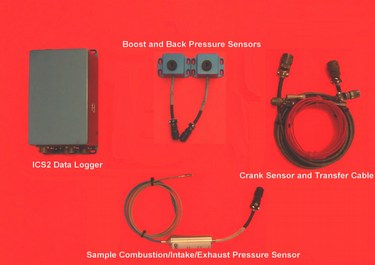
ICS2.jpg
SparkplugSensors.gif


Need to freshen up on my talk game though , the wife doesnt fall for my old tricks anymore and its time for some new angles .
 

The Bronze

New member
Re: Engine pressure analysis tuning

The company as pictured below (TFX) low cost system is $2495 (2 channel). The LCS 4 channel is $3695. Of course there is a 5 channel with live display that runs $3995. You also need an plug (you would likely want your regularly run plug) modified with a pressure transducer, which costs $1295. I don't got that kind of money floating around.

The tech was good enough to email me some specifics about why their data analysis system is so good. It is kinda cool to be able to scope MAP, Exhaust and combustion pressure to make determinations, but I already have 2 of those sensors. A high resolution crank sensor might be kinda nifty, but really we can run the crank sensor at TDC or properly locate it and do the calculations off of that based on time to the next TDC (720 degrees) to know the pressure/piston relationship. Throw an inductive spark probe on the plug wire, graph the MAP, primary ignition pattern, through an exhaust probe in the tailpipe and you have yourself a party! Heck if I had an 8 channel scope instead of 4, you could add the wideband in real time and suprise yourselves on how sensitive the sensor is compared to what the Datamaster or gauge is showing you.

The bottom line is that via the SAE website and a few (hundred) bucks, I can get enough engineering papers to work out a better understanding of MBT vs Mass Fraction Burned and come up with a good way to calculate not only where best mechanical advantage over the crankshaft occurs, but a good idea where the fuel is being consumed as well.

The additional components to make this work for me is simply the fiber-optic pressure sensor incorporated into one of my plugs and a power supply. While it won't do the math for me, it will give me (within reason; the sensor inside the plug shell will likely "soften" the pressure waveform a bit depending upon plug angle, depth of plug, electode shrouding and such..) a good waveform, triggered to TDC that I can use to determine where combustion pressure is compared to crankshaft position. If I understand correctly that MBT is usually found when approximately 50% of the fuel shot is consumed at around 4-16 degrees ATDC, then we should be able to fine tune for a cylinder pressure peak that is not only putting pressure on the piston to provide maximum brake torque without knock (and at much lower amounts than the knock sensor will ever be able to identify), but also that pressure isn't wasted into the intake track due to reversion and/or backpressure, nor is it burning out the exhaust valve or being held up by a restriction due to mechanical obstruction or exhaust collector tuning. That is where the MAP sensor and exhaust pressure transducers come into play. Once again the timing of that would have to be figured out, which is why some should hit the easy button and pay for the software. I feel that 1/3 of the cost will get me 80% of the way. I doubt that I would fiddle with header collector tuning or intake runner tuning, but if I was running a 11.00, I probably might. ;)

A Pico scope is nice, I run a 4 channel from ATS which is pretty good. I also have cylinder pressure transducers, vacuum transducers, exhaust pressure transducer, primary and secondary ignition attachments, high and low current probes and such to keep wires wrapped all around my legs, arms and the occasional fan blade....:oops:

I used to connect the current probe to measure relative compression, but found it was just as reliable to watch AC voltage during cranking since it is also just a representation of the actual cylinder pressure (and starter condition). There are a few other benefits as well. Here is a waveform that I snapped outside at near 30 below. This car had been to a number of shops and nobody could get the OBDII monitors to set to complete. Long story short, I went outside to the car that had just pulled up to the office, hooked up my scope leads to the battery, disabled the coil and cranked it over. 30 seconds later I told her how to fix her car.

Ignitionprimarymissingtrigger.png


You can see the battery voltage drop to about 8V when it initially cranks over. That is enough to cause an ECM reset, which clears the monitors of course. Since this vehicle needed to drive-cycles to complete the monitors, every time it was restarted to run the second drive-cycle it reset. You can also see the battery voltage was low KOEO, but it was charging over 14V running......

Scopes and their accessories are awesome. I think that while this transducer will not only good tuning capabilities, but will also be able to identify real knock from "phantom knock".

If it means getting the transducer to Nats or not, I might get it dropped-shipped to the hotel or to a friend to save one or two days travel time.
 

The Bronze

New member
It looks like they will have the sensor to me before I fly out to Nats. I doubt I will have the ability to put in any practice. No promises.

I forgot to mention that the TFX system appears to use the Optrand sensor, so should I need upgrade to the software package, I don't have to fork out for another sensor.
 

turbodig

Active member
Re: Engine pressure analysis tuning

I was thinking about a couple of these, possibly. My intent was to capture real-time spark current, and get an idea of ignition performance from that. You could probably read pressure sensor signals with it and trigger from TDC.

http://www.goodluckbuy.com/hantek-dso3064-automotive-diagnostic-oscilloscope.html

A simple mag sensor on the flywheel would give you a more accurate reference (when combined with a TDC trigger) than simple time domain. In a constant RPM environment time is ok, but with RPM increasing/decreasing it'd be a better deal to have some sort of degree reference, even if it is only 2 degree resolution or so.

Somebody will figure out an economical pressure sender someday, and it'll revolutionize things. Wide-bands used to be $5k propositions from Horiba...
 

qbnkiller

Conflaguration Specialist
Re: Engine pressure analysis tuning

Intrigued, I contacted them today. For a two-cylinder analysis package (two custom spark plugs, two intake pressure sensors, two exhaust pressure sensors, crank sig, software) it would be approximately $14,000.

...just floating that out there...great tool but still pretty damn expensive.
 

The Bronze

New member
Re: Engine pressure analysis tuning

I was thinking about a couple of these, possibly. My intent was to capture real-time spark current, and get an idea of ignition performance from that. You could probably read pressure sensor signals with it and trigger from TDC.

The voltage waveform is probably the picture you are looking for to see what is happening in a cylinder. If you "current ramp" the coil there you can see coil, power and ground conditions, including partially shorted coils, but you would have to have a pretty special current probe to look at voltages that have a kV after them. My best one only goes to 600 amps. The art of looking at secondary ( or even primary ) voltage is pretty sketchy at times with even a $3k DSO. An analog ignition scope is better, but you will still be left wondering if that cylinder was really a bit lean/rich or not. It only goes downhill from there, although it is fabulous for for misfires and determiningbwhere it occurred in the secondary.
 

MRKING

New Parts for Old Trucks
Re: Engine pressure analysis tuning

I figured the whole system would be expensive if the plug sensor was alot by itself . Code 59 needs a home brewed version for syty's in 2012 . :rock:
 

The Bronze

New member
Re: Engine pressure analysis tuning

Stuck here at the airport, so I decided to post up a couple of waveforms from Justin's Ty. The first one is cylinder pressure at idle. The yellow trace is cylinder pressure (transducer voltage). The blue trace is his injector current. When you look at the 2nd waveform (under load), you can see the injector on-time is much greater. The red trace is an inductive spike that represents his spark firing on #1, which is the cylinder we are testing (out of ease). There is noise on that trace that wasn't from #1, but was from other cylinders. It looks like this needed a 10:1 filter to help remove that noise (and Justin needs to seperate his wires, to prevent real cross-firing when the kV gets high under load).


JustinTyphoonidlecombustion.png


This next one is with the engine under boost, sitting in the parking lot on the brakes. There is another trace, also blue that represents the other cylinder TDCs. I added it, not to make it more confusion, but to illustrate the information available to help determine what is happening, and what other events are affecting it.


JustinTyphoonbraketorquecombustion_2.png

ur

Here is his vacuum waveform at idle. You can see that vacuum is averaging around 14.5" (what you would see on a mechanical gauge or datamaster. Each This can be done right through your MAP sensor, but you still need to use a scope to see it. On this one, you can see about 8 cylinder intake events, raising the vacuum. This is very stable. The red trigger trace is once again showing a phantom spark event, The first one is actual TDC, as it has a much higher peak voltage. This would be an example of a waveform that should have been resaved to make it clear.


JustinTyphoonidlevacuum.png
 

The Bronze

New member
Re: Engine pressure analysis tuning

Still working on this. I picked up some graphic overlays and a program that will allow me to produce a pretty cool animated gif complete with annotations. I also have been collecting reference material on not only the in-cylinder pressure transducers (both spark and non-spark), but also on valvetrain effects on combustion. Interesting reading.
 

MRKING

New Parts for Old Trucks
Re: Engine pressure analysis tuning

I knew the data from a Syty engine would reveal phantom issues . Is working them out within the limits of the stock ecm possible though ?
 
Top